Best time to comment on LinkedIn: does early win?
Early comments earned about 3.8 times more impressions in one 261,137-comment study. What it proves, what it does not, and a routine for any time zone.

Part of our LinkedIn comments guide: where to comment, what to write, and how to measure what it earns.
What is the best time to comment on LinkedIn? Soon after the post goes live is better than a day later, but speed alone is not what wins. In one large vendor study, comments posted within 30 minutes averaged 3.8 times more impressions than comments posted after 24 hours.
That sounds like a race. It is not quite one. LinkedIn now orders comments by how relevant they are to each reader, and the study has limits. This article separates what was measured from what is guessed, and gives a routine you can follow from any time zone. It adds to our LinkedIn comments guide.
Does it matter how early you comment on LinkedIn?
Yes, it seems to matter, but by less than the headline suggests. The best public evidence we found is a study by LinkHub, a LinkedIn tool vendor. It looked at 261,137 real comments and the delay between the post going live and the comment being posted.
The pattern was steady. The longer people waited, the fewer impressions the comment earned on average.
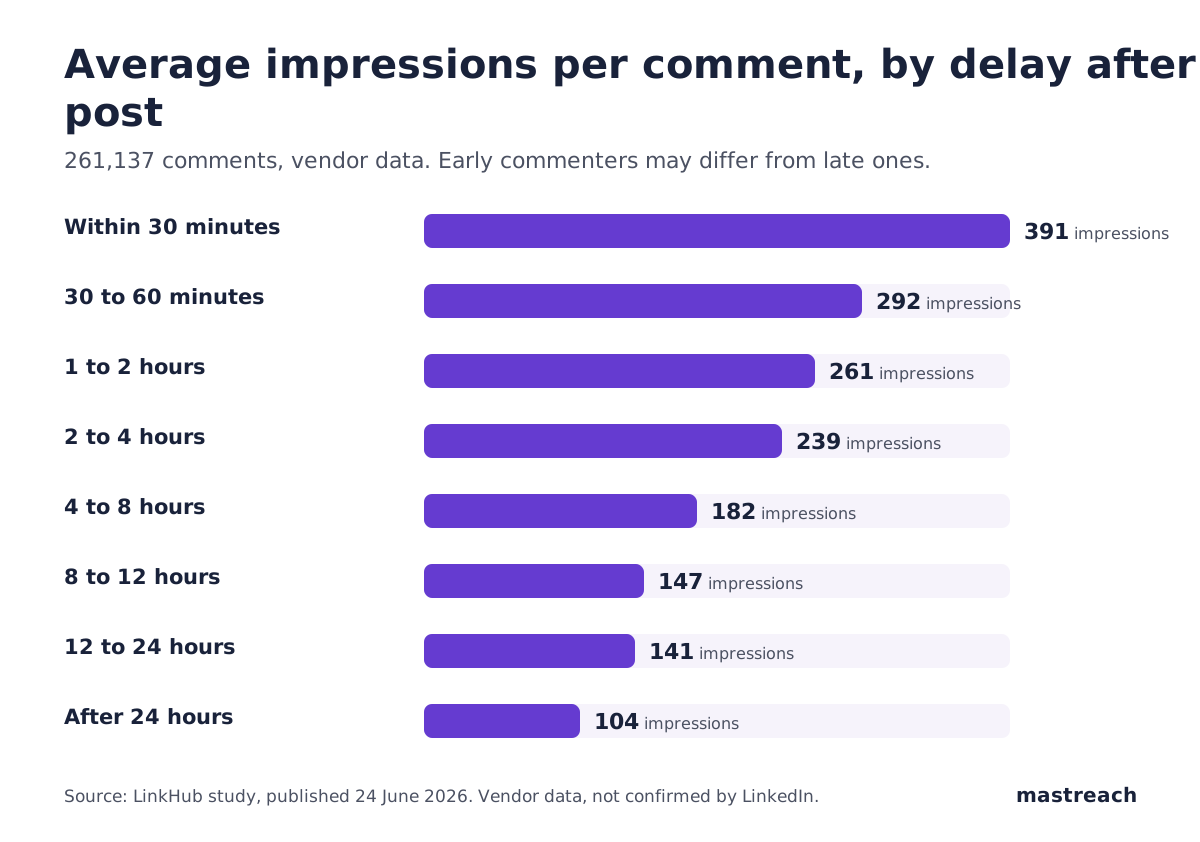
The median tells the same story with smaller numbers: 95 impressions within 30 minutes and 22 after 24 hours. A few comments that did very well pull the average up, so the median is the more typical result.
What does this data not tell us?
Three things, and they matter.
It is one vendor's data. LinkedIn has not confirmed it. LinkHub sells a tool built around early commenting, so it has a reason to like this result. We say that without doubting the numbers, only so you can weigh them.
It shows a link, not a cause. People who comment within minutes are often active, well-connected accounts who watch certain authors closely. Their comments might do well at any hour. The study cannot separate the timing from the commenter.
It describes the past. LinkedIn announced in August 2026 that comments are shown by relevance to each reader, using professional interests, connections and engagement activity. The study was published in June, before that change was reported.
We have no timing split of our own. Across 914 comments drafted in Mastreach and then posted, LinkedIn reported 177,931 impressions, about 195 per comment. Those are impressions as LinkedIn reports them, not unique people, and we did not compare them by posting time.
Does comment ranking per reader change the first-comment advantage?
Probably, but nobody outside LinkedIn can say by how much. If every reader sees a different comment first, being first on the page is worth less than it was. Our reading is that early still helps you be seen while a conversation is active, and relevance decides whether the right people see you.
We cover the ranking change in LinkedIn comment ranking: what "top comment for you" means.
A related point comes from Richard van der Blom, who studies LinkedIn's algorithm. In his 1 November newsletter he writes that 85% of a post's reach arrives after its first two hours in 2026. That is about posts, not comments, and it is his own measurement of over 1.2 million posts, not a LinkedIn statement. Still, it fits a simple picture: a post stays alive for days, so a thoughtful comment on day two can still find readers.
Which days and hours suit buyers in different countries?
We do not have reliable evidence for a best hour. Advice you see online usually comes from data on posts, and it assumes one time zone. Your buyers may be in several.
A better question is when your buyers read. Think about the person, not the clock:
- A US agency owner may scroll in the morning before meetings.
- A UK consultant may read at lunch or on the train home.
- A Dubai firm's director may read early, before the working day fills up.
- An Indian founder may read late in the evening.
Instead of guessing, look at when the authors your buyers follow tend to post, and when their comment sections are busy. Then comment in that window. Your own comment impressions will confirm it within a month.

What if you find the post 24 hours late?
Comment anyway if you have something real to add. The study's slowest group still averaged 104 impressions, not zero. A late comment with a sharp detail often starts a smaller, better conversation than a rushed early one.
A late comment is worth it when:
- the post still has comments arriving;
- you have a fact, number or story the earlier comments lack;
- the author is someone your buyers read.
It is not worth it if your remark would fit under any post. Our article on how long a LinkedIn comment should be shows how to say one point in two or three sentences.
What is a 20-minute timing routine for a busy consultant?
You do not need to watch LinkedIn all day. Three short visits a week is enough to start.
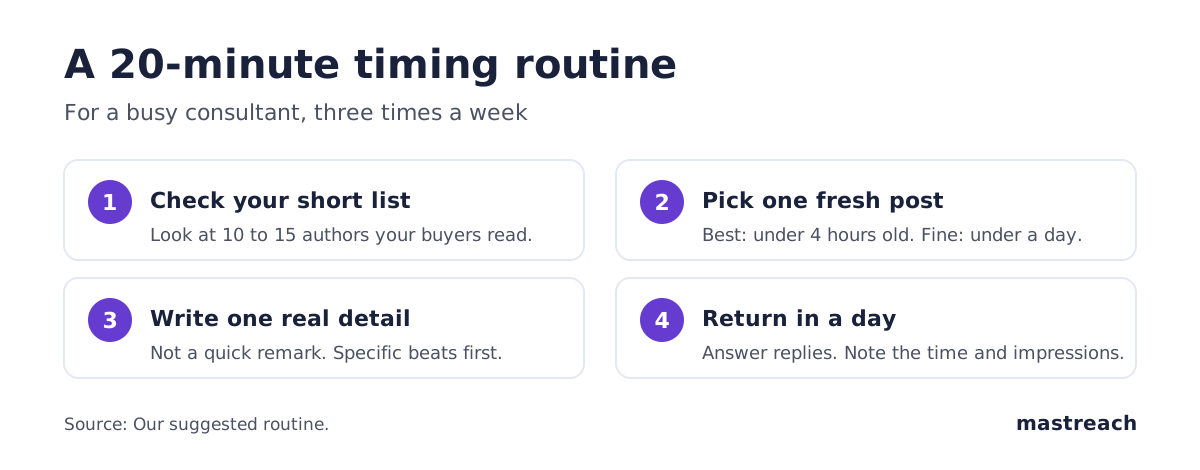
- Keep a list of 10 to 15 authors your buyers read. Ask three clients whom they follow.
- Visit the list at the same time on three days. Pick the freshest post where you have something real to add.
- Write one specific point from your own work. If you cannot, skip the post. A skipped post costs nothing.
- Come back the next day. Answer replies. If you are the post's author, you can also pin a helpful comment.
Post every comment yourself. LinkedIn says it acts against comments posted at scale by automation, so a human pace is also the safe one.
How do you check your own timing with comment impressions?
LinkedIn shows an impression count under each of your own comments, visible only to you. It does not add them up. To learn your own best timing:
- Write down, for each comment, the post's age when you commented (under 1 hour, 1 to 4, 4 to 24, over 24).
- Check the impression count after three to seven days.
- After a month, compare the groups. If you have fewer than about 30 comments, treat any pattern as a hint.
Compare comments on similar authors. A comment under a very large account will beat one under a small account at any hour, which can hide the effect of timing.
Where Mastreach fits
Timing matters most when you can find the right post quickly and say something worth reading. That is the slow part, and it is where Mastreach helps.
- It shows posts in your subject that your buyers are reading, so you see them while they are fresh.
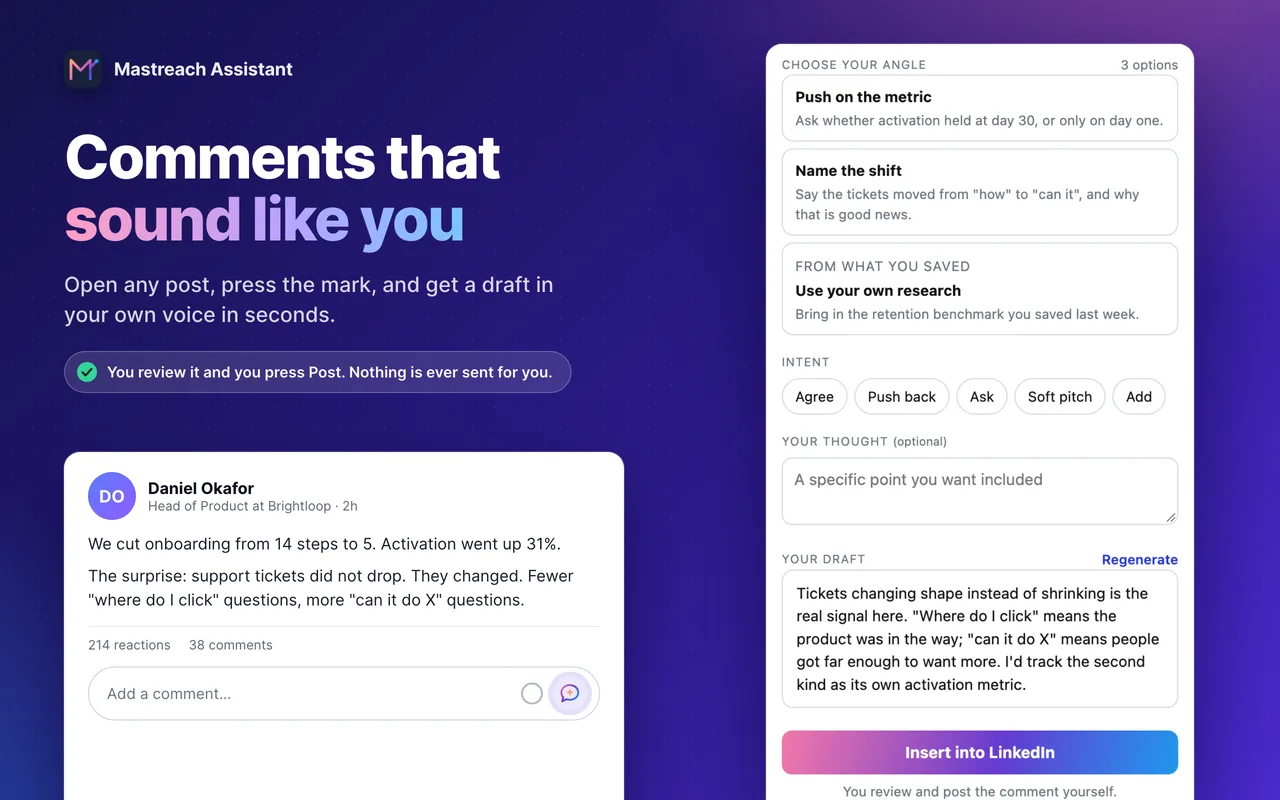
- On any post, you pick an angle and get a draft in your own voice, which you edit.
- It records the impressions LinkedIn shows under each comment and adds them up by week, post and author.
You read, edit and post every comment yourself. Mastreach never posts or messages for you.
The 5-day free trial needs a card but charges nothing during the trial. Plans start at $29 a month at the founding price.
FAQ
Is it better to comment early on a LinkedIn post?
Usually a little, yes. One vendor study of 261,137 comments found more impressions for early comments. It is not confirmed by LinkedIn, and a specific comment still beats a fast, empty one.
What is the best day to comment on LinkedIn?
We found no reliable evidence for one best day. Most day and hour advice comes from data on posts in one time zone. Comment when your buyers' authors post and read.
Can you comment on an old LinkedIn post?
Yes. Late comments can still earn impressions, and a detailed one can start a good conversation. Do it when the post still has activity and you add something the others missed.
Does LinkedIn show comments in the order they were posted?
Not any more for everyone. LinkedIn announced that comments are shown by relevance to each reader, so the order can differ between readers.
Sources
- When to comment on LinkedIn? A study of 261,137 real comments (LinkHub, 24 June 2026)
- The First Hour of your LinkedIn Post is Lying now (Richard van der Blom, 1 November 2026)
- LinkedIn updates feed display to drive more post replies and comments (Social Media Today, 9 August 2026)
- Keeping conversations real on LinkedIn (LinkedIn Pressroom)
- Mastreach account data, August to September 2026. Only comments drafted in Mastreach and then posted are counted.
See what your own comments are reaching.
Mastreach finds the LinkedIn posts your buyers are reading, drafts a comment in your voice, and counts the impressions LinkedIn never adds up for you. You post every comment yourself.
- 914 comments drafted with Mastreach and posted by their owners
- 177,931 LinkedIn impressions on those comments, August to September 2026